Nissan Retires 'Datsun,' the Name America Knew, and Spends a Reported Half-Billion Teaching Everyone the New One
In 1981 only 13% of American buyers knew what 'Nissan' meant. So the company that owned one of the best-known car brands in America spent five years and, by its own count, roughly $500 million teaching everyone the new one.
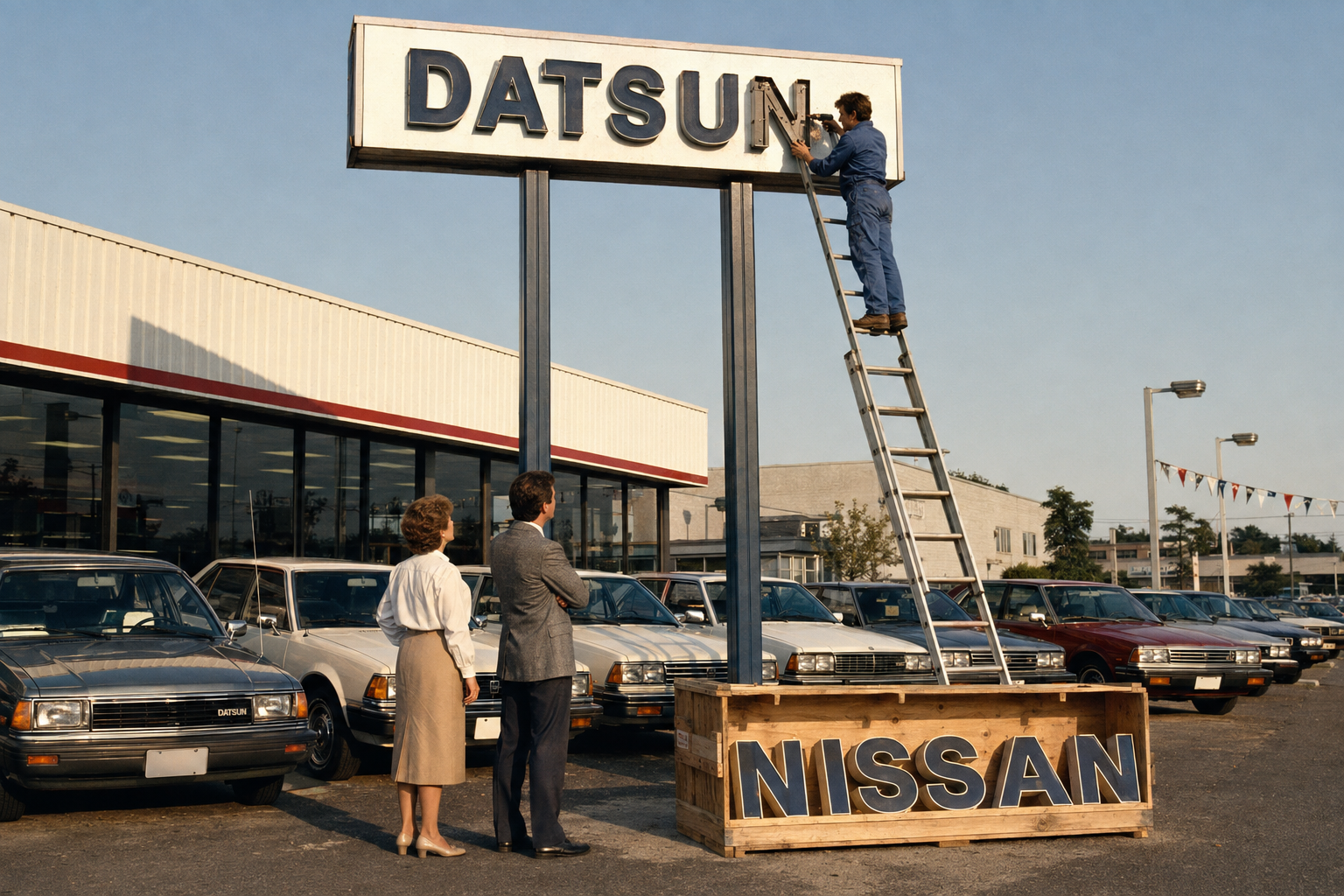
In July 1981 the people who made Datsun automobiles looked at one of the best-known car brands in America and decided the real problem was the name on it. Datsun had been selling in the United States since 1958. Everybody knew it, most people trusted it, and it moved metal. The complaint was strictly internal. Back home in Japan the company called itself Nissan, and somebody upstairs could not live with the exports saying something else. The switch, a spokesman explained, would “better identify our worldwide vehicle lineup” and “unify our international image.”1
The unification arrived with an awkward statistic attached. At the time, by the company’s own count, 13 percent of American consumers had any idea what “Nissan” was.1 So the plan was to take a name almost everyone knew, replace it with one almost nobody did, and pay full retail for the downgrade. The Datsun badge started vanishing with the 1982 Stanza. Management figured a year, maybe two. Instead it dragged on through a fleet of visibly confused cars stamped “Datsun by Nissan,” while some 1,100 dealerships slowly reprinted their signs deep into 1985 and 1986.2
The tab, by Nissan’s own later math, came to about $500 million. Thirty million bought new dealer signs. Two hundred million bought ads for the name nobody recognized. And roughly fifty million bought Datsun commercials that were shot and then never aired, because by the time they were ready the brand they advertised was being deleted. It takes a special kind of committee to spend fifty million dollars promoting a word and pulp the tape before it airs.3
The dealers, who had just bought the old signs, learned the news by press release. “I think it is the worst thing they could do,” said a South Carolina dealer fresh off dropping thousands on signage. “I will be one of the fighters.” A Staten Island sales manager kept it to eight words: “Nissan doesn’t ring a bell like Datsun.” A California manager just said the quiet part loud: “Who knows Nissan? Why change something that has been successful?”4 The ad slogan, meanwhile, slid from the swaggering “Datsun, We Are Driven!” to the faintly pleading “The Name is Nissan.”3
Americans did learn it. It only took a few years and a reported half-billion dollars to rebuy the recognition the old name had been handing over for free. Marketing professors have been dining out on the story ever since; David Aaker opens his standard brand-equity textbook with it.5 Datsun was never broken. It was just mildly annoying to own two names, and they fixed that inconvenience for five hundred million dollars.
Who knows Nissan? Why change something that has been successful?— Andy Spindler, California Datsun sales manager, July 1981
References & Citations
- UPI Archives — "A Datsun by any other name ...," James V. Higgins, July 17, 1981, upi.com.
- The Christian Science Monitor — "Datsun builders phase out the name to build company's global image," Oct. 21, 1981, csmonitor.com.
- Cost and slogan figures are as reported in Nissan's own 1985 “Facts Booklet” (company-reported, not independently audited), scans via datsunforum.com; the same figures are cited in Aaker (1991), below.
- UPI Archives — "Nissan is driving out Datsun name," James V. Higgins, July 18, 1981, upi.com.
- David A. Aaker, Managing Brand Equity: Capitalizing on the Value of a Brand Name (The Free Press, 1991), which opens its brand-name chapter with the Datsun-to-Nissan case, simonandschuster.com.