On the Continental Bills of Credit, and Their Improvement Into Worthlessness
Wanting any power to tax, the Congress paid for its war with paper promises. These served well enough, until Congress, hard pressed, rewrote the terms of its own notes; whereupon the Publick ceased to believe them, and a paper dollar came to fetch a penny of silver, and then less.
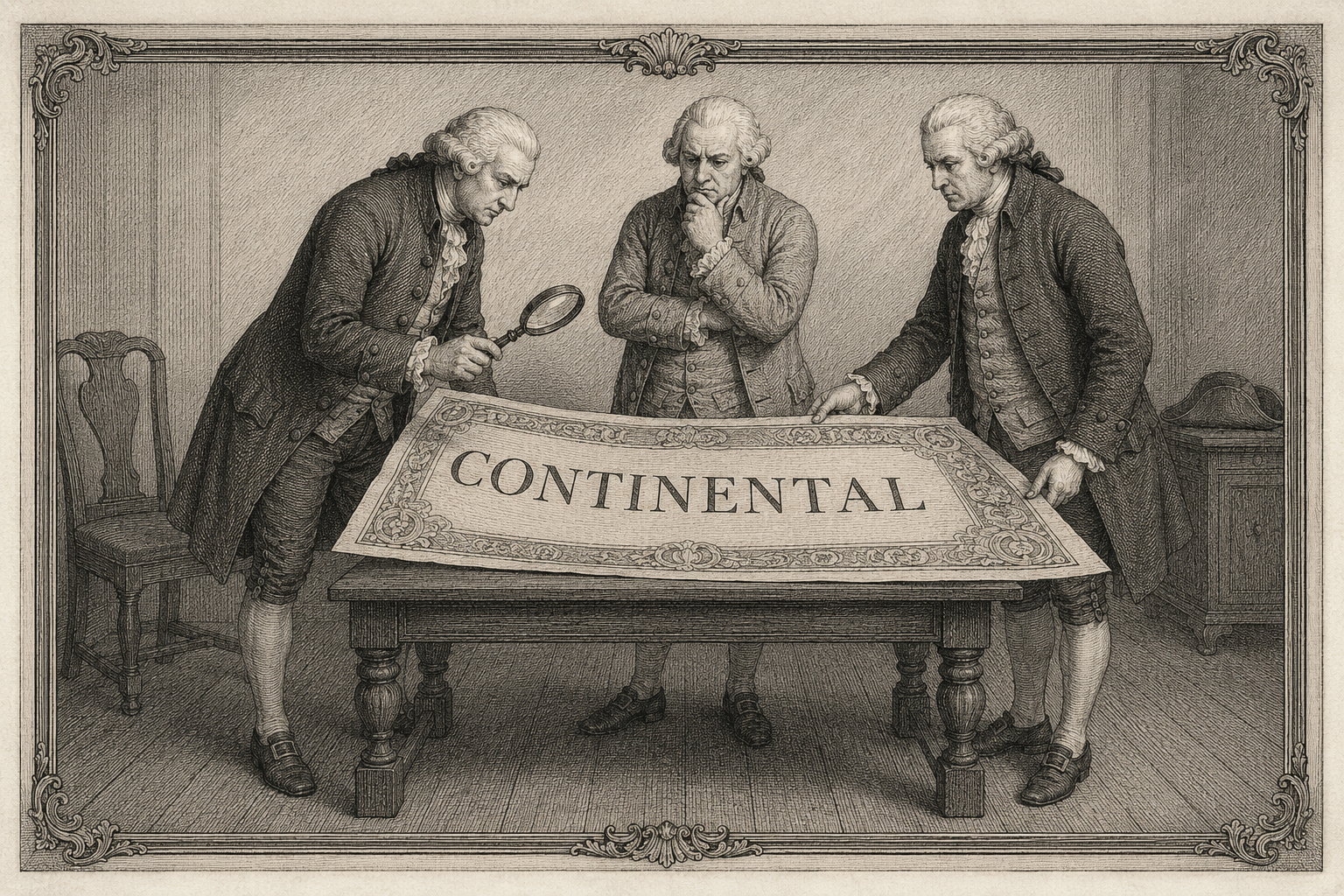
PHILADELPHIA. It is a settled principle among the friends of Liberty that a people ought not to be taxed but by their own consent; and the Congress, having gone to war upon that very principle, found itself in the year 1775 possessed of an army to pay and no lawful means of taxing any man to pay it. The expedient adopted was paper. Beginning that May the Congress emitted bills of credit, dollars printed not upon gold in hand but upon the promise of redemption at some future and unspecified day, and with these it purchased the war.1
For a season the contrivance served tolerably well. The bills went from hand to hand; the soldier was paid, the miller sold his flour, and the Publick, extending to the Congress that credit which no law could have compelled, carried the Revolution upon its faith. Learned men have since observed that in these first years the paper suffered no great loss, being taken as a kind of promissory note drawn upon a victory not yet won.2
The difficulty arose not from the quantity of paper alone, though the emissions grew prodigious, some two hundred millions and more by the year 1779; it arose from what the Congress did next. Pressed on every side, and unable to honour its notes upon the terms first given, it resolved in March of 1780 to call in the old bills and issue new ones at the rate of forty for one.4 This was, in plain speech, to inform every holder of a Continental dollar that it should thenceforth be reckoned worth a fortieth part of what he had been promised, and to alter, after the fact, the very bargain upon which he had parted with his goods.
Whereupon the Publick did the one rational thing remaining to it, and ceased to believe. The new bills sank as the old had sunk; by the opening of 1781 a hundred paper dollars would fetch but one of silver, and afterward a great deal less; a suit of clothes, it was reported, might be purchased for a million.1 Colonel Hamilton, surveying the wreck that summer, wrote that the currency had “depreciated, till in many places it will hardly obtain a circulation at all.”3
Thus was a working expedient improved into a proverb. The bills had done their office so long as men trusted the promise behind them; and the Congress, in the very act of labouring to save its credit, taught the Publick that the terms of its promises were subject to revision, than which no surer method of destroying credit has yet been devised. The saying “not worth a Continental” is with us to this day, though the antiquaries dispute the hour of its first utterance, some finding no certain trace of it until long after the events it describes; it stands, whenever it was coined, as a monument to the discovery that a debt is not mended by the simple act of declaring it smaller.2
depreciated, till in many places it will hardly obtain a circulation at all.— Alexander Hamilton, "The Continentalist No. III," 9 August 1781
References & Citations
- Federal Reserve Bank of New York, Liberty Street Economics — “Crisis Chronicles: Not Worth a Continental,” April 2014, newyorkfed.org.
- Farley Grubb, “The Continental Dollar: Initial Design, Ideal Performance, and the Credibility of Congressional Commitment,” NBER Working Paper No. 17276 (2011, rev. 2013), nber.org. Grubb argues the collapse followed Congress altering redemption terms after the fact, and questions whether the phrase was contemporary at all.
- Alexander Hamilton, “The Continentalist No. III,” 9 August 1781, Founders Online, National Archives, founders.archives.gov.
- “Continental Scale of Depreciation of currency from September 1, 1777 to March 10, 1780; agreeable to an ordinance of Congress,” Northwestern University Libraries Digital Collections, dc.library.northwestern.edu.