Congress Tidies Up the Mint and, in the Doing, Quietly Demonetizes Silver
A dense 1873 housekeeping bill dropped the silver dollar with hardly a word of debate. Nobody much noticed until the price of silver fell out from under the West, which then noticed for twenty years.
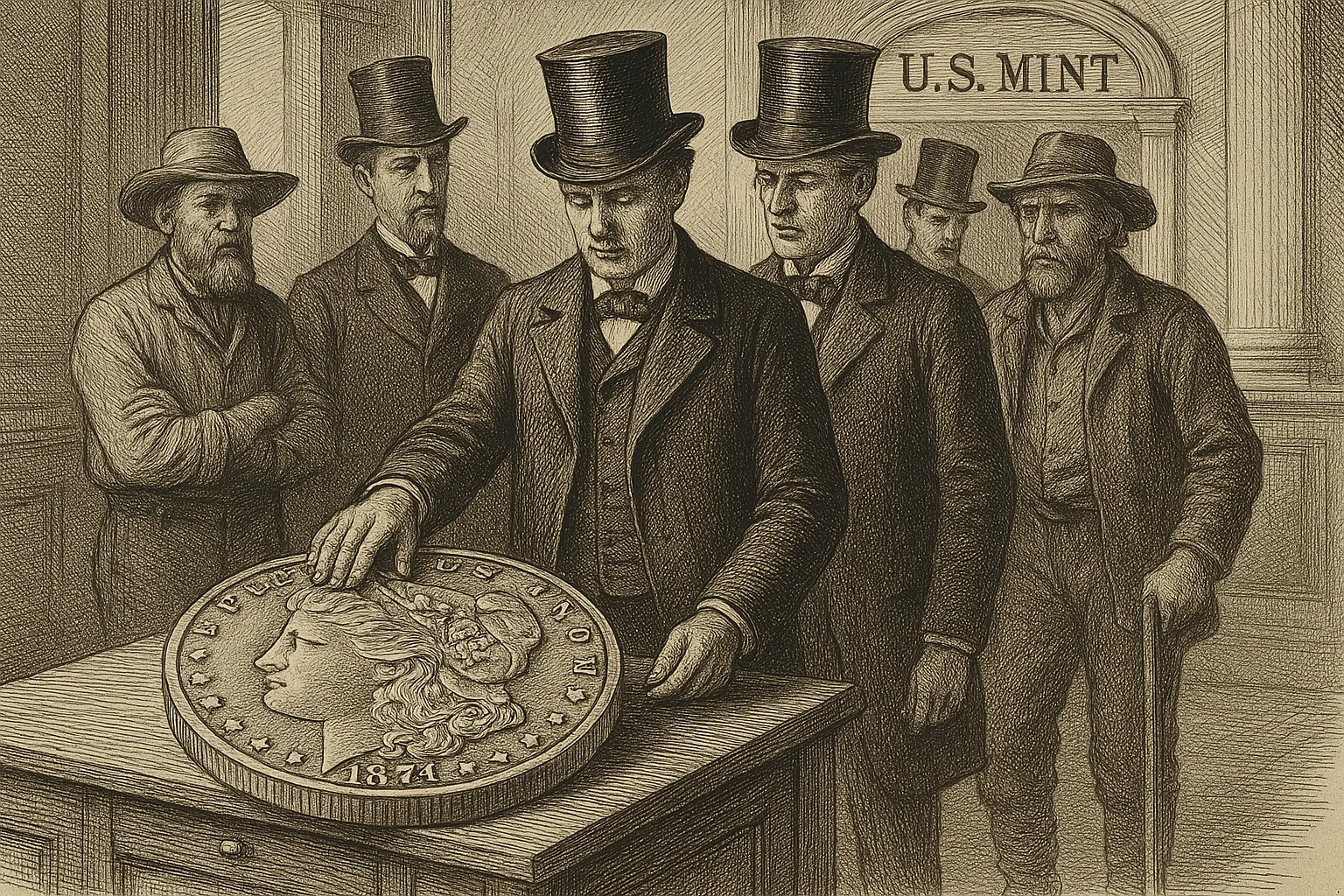
For eighty years the American dollar had stood on two legs. Ever since the Mint Act of 1792 a man might carry either gold or silver to the Mint and walk out with lawful coin; the standard silver dollar was money, plain and simple, and the country had gotten along on this arrangement of two metals without any great complaint. It was not a glamorous system. It was, however, a working one.1
Then, on the twelfth of February, 1873, President Grant put his name to a Coinage Act — a great sprawling thing of sixty-seven sections, the most of it dry housekeeping touching the running of the Mint. Somewhere in that thicket, without fanfare and with precious little debate, the standard silver dollar was struck from the list of coins the Mint would make, and the old right of any citizen to bring his silver to be coined into legal-tender dollars was quietly done away with; in its place the Congress offered a “Trade dollar,” a coin got up chiefly for shipment to the Orient.2 The bill had been knocking about the Capitol the better part of three years, and hardly a soul rose to speak against the silver clause.3
Nobody hollered, for at the moment nobody noticed; that would change directly. The Comstock Lode and its sister diggings were fixing to pour a mountain of new silver onto the market, and the law, by shutting the Mint's door to silver just as the supply came flooding in, helped knock the bottom clean out of the price. The Panic of 1873 arrived the same year, and behind it came the slow grinding deflation of a country hitching itself, by accident and design both, to gold alone. For the farmer and the miner and every man who owed money it was a cruel piece of arithmetic: the dollars they had borrowed grew dearer by the year, while the wheat and the ore they sold to earn those dollars grew ever cheaper.4
What had passed for a tidy bit of bookkeeping was, in the looking back, remembered as something a good deal darker. Out on the plains and in the silver camps they gave it a name — the “Crime of ’73” — and told one another it had been slipped through by the money power and the eastern banks to cheat the common man of easy money. Conspiracy or blunder, the deed lit a fire that burned a generation. The Free Silver men rose up demanding the white metal be coined again, and a nervous Congress passed the Bland–Allison Act in 1878 and the Sherman Silver Purchase Act in 1890 to buy silver back into the money by halves.1
The reckoning came at the last in the summer of 1896, when a young Nebraskan named William Jennings Bryan stood before the Democratic convention and turned the whole long grievance into scripture: “You shall not press down upon the brow of labor this crown of thorns; you shall not crucify mankind upon a cross of gold.” It won him the nomination on the fifth ballot.5 It had taken the Republic three-and-twenty years to finish quarreling over a silver clause that most of Congress had waved through without a second look. The dollar had been standing well enough upon two legs; somebody, in the course of tidying up, had kicked one clean out from under it.1
You shall not press down upon the brow of labor this crown of thorns; you shall not crucify mankind upon a cross of gold.— William Jennings Bryan, the 'Cross of Gold' speech, July 8, 1896
References & Citations
- U.S. Mint — "Mint History: The 'Crime of 1873'," usmint.gov.
- U.S. Statutes at Large, Vol. 17, p. 424 — Coinage Act of February 12, 1873 (full statutory text), govinfo.gov.
- Federal Reserve Bank of St. Louis (FRASER) — "Coinage Act of 1873," fraser.stlouisfed.org.
- Encyclopaedia Britannica — "Free Silver Movement," britannica.com.
- Teaching American History (Ashbrook Center, Ashland University) — "The Cross of Gold Speech," July 8, 1896 (full text), teachingamericanhistory.org.